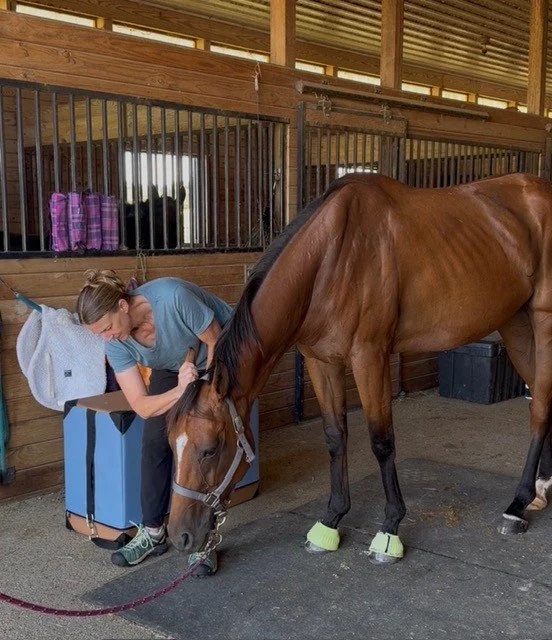
What is myofascial release (MFR) therapy?
Helping your horse move with greater freedom, comfort, and balance.
Every movement your horse makes depends on a healthy, responsive network of muscles and fascia. Fascia is the connective tissue that surrounds and supports muscles, joints, organs, and other structures throughout the body. When fascia becomes restricted or loses its normal ability to glide and move, it can contribute to areas of tension, stiffness, and altered movement patterns.
Myofascial Release (MFR) is a gentle, hands-on bodywork technique designed to address restrictions within the fascial system. Rather than simply working on the surface of a tight muscle, MFR focuses on the interconnected tissues that influence how the entire body moves. Using sustained, intentional pressure and careful observation of the horse's responses, MFR encourages the tissues to soften, lengthen, and regain more natural mobility.
At Second Flight Equine, MFR is approached as more than simply "working out a knot." Each horse is an individual, and their body tells a story through posture, movement, muscle tone, and response to touch. The goal is to identify areas of restriction and help the horse move toward greater physical balance and ease.
Why Might Your Horse Benefit from MFR?
Horses don't always tell us when something doesn't feel right. Instead, they often communicate through changes in movement, behavior, posture, performance, or willingness. A horse that suddenly feels different under saddle, becomes resistant to certain movements, struggles to stretch, or simply doesn't seem as comfortable as usual may be expressing a need for closer attention to their body.
MFR may be beneficial for horses experiencing muscular tension, stiffness, restricted range of motion, uneven movement, or physical demands associated with training and performance. It can also be a valuable component of a proactive wellness program for horses whose owners want to support comfortable, efficient movement before minor restrictions become more noticeable problems.
For performance horses, the demands of jumping, dressage, eventing, hunting, racing, western disciplines, or other athletic activities place repetitive stress on the body. Even everyday activities such as turnout, trail riding, loading, or maintaining a particular posture can contribute to areas of tension. Helping the fascial system remain mobile may support more fluid movement and allow the horse to perform everyday tasks with greater physical ease.
What Could You Notice?
The benefits of MFR aren't always dramatic or immediate—and they don't need to be. Sometimes the changes are subtle: a longer stride, easier bending, a more relaxed topline, improved willingness to stretch, or a horse that simply feels more comfortable in their own body.
You may notice your horse:
Moves more freely and comfortably
Shows improved flexibility and range of motion
Carries less visible muscular tension
Finds it easier to stretch and relax
Moves with greater fluidity and symmetry
Recovers more comfortably from physical activity
Becomes more willing to engage in movement that previously felt difficult
Appears more relaxed and comfortable during and after bodywork
MFR isn't about forcing a horse into a particular position or trying to "fix" the body in one session. It is about listening to the horse, respecting the body's responses, and working with the tissues rather than against them.
A Proactive Approach to Equine Wellness
You don't have to wait until your horse has an obvious problem to pay attention to their body.
Just as athletes benefit from thoughtful body maintenance, horses can benefit from regular attention to the physical demands placed on them. Incorporating MFR into your horse's wellness routine can be one way to support healthy movement, comfort, and body awareness throughout their career.
Whether your horse is a seasoned competitor, a trail partner, a lesson horse, or simply your beloved pasture companion, every horse deserves the opportunity to move as comfortably and freely as their individual body allows.